
Grab Bar Installation Guide
Grab Bar Installation Guide: What Holds a Grab Bar to the Wall
A grab bar is as strong as what it is screwed into. What the bar has to reach, how that changes by wall type, what a professional installation includes, what goes wrong, and what installation costs.
A grab bar holds a person because of what it is screwed into, not because of the bar. The 2010 ADA Standards set the reference load at 250 pounds applied at any point on the bar, the fasteners, the mounting, or the supporting structure, and that last word is the whole subject of installation. Behind the tile in most of the bathrooms we visit across Southern California there is drywall and nothing else. No wood blocking was installed when the house was built, so a bar cannot be screwed into "the wall." It has to reach a stud, or blocking has to be added behind the wall, or a load-rated anchor designed for that wall has to carry the load. What each of those means, how tile, fiberglass, and plaster change the job, and what a professional installation includes follow.
- The wall decides. A 500-pound bar in drywall alone holds what drywall holds. The bar has to reach a stud, blocking, or a load-rated anchor matched to the wall.
- Most homes have no blocking. Tile over drywall with nothing behind it is what we find on most visits. The stud is rarely where the hand lands.
- Wall type changes the approach. Tile, fiberglass and acrylic surrounds, plaster, and cement board each need a different way to reach structure.
- Plastic anchors and towel bars are the two failures we find most, and both come out of the wall under a person's weight.
- Placement comes before anchoring. The bar goes where the person's hand lands; the anchoring is made to fit that spot, not the other way around.
Why does the wall matter more than the bar?
The wall matters more than the bar because the load rating on a grab bar applies to the whole assembly, and the wall is the part that fails. The 2010 ADA Standards, Section 609.8, require that a vertical or horizontal force of 250 pounds applied at any point on the bar, the fastener, the mounting device, or the supporting structure not exceed the allowable stress of any of them. Manufacturers say the same thing in their own words: their designer lines are rated to 500 pounds "when installed into a stud." The rating is a promise about the bar and the structure together. Screw the bar into drywall and the promise no longer applies.
The failure is not gradual. A bar that pulls out does so when a person has already committed their weight to it, in a fall, with nothing else to hold. On home visits, roughly 1 in 10 bathrooms had a grab bar of any kind, about 3 in 4 had a towel bar being used as one, and of the bathrooms that did have a bar, about 1 in 3 had it where the person could not use it. Bars screwed into tile with plastic anchors are one of the failures we find most often. The bar looks installed and holds a hand. Under a fall the anchors back out of the drywall and the bar comes off the wall.
What does a grab bar have to be anchored into?
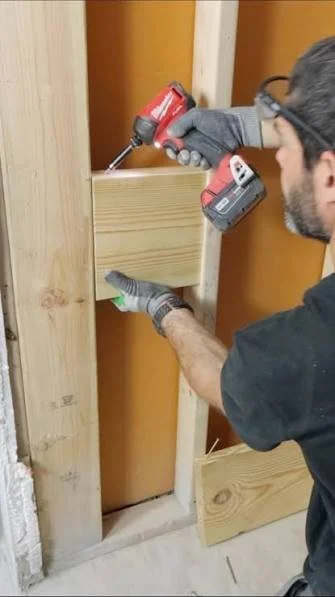
A grab bar has to be anchored into one of three things: a wall stud, wood blocking installed between studs, or a load-rated anchor designed for the wall type and rated for the bar's load. Each has a condition attached.
A stud
The strongest and simplest anchor is a stud, the vertical framing member behind the wall, with the bar's mounting flange fastened through the wall surface into the wood. The condition is that the stud has to be where the bar belongs. Studs sit at fixed intervals, and the place a person's hand lands when stepping into a shower or pushing up from a toilet almost never falls on one. A bar placed on the stud instead of where the hand lands is the fifth failure on the list below.
Blocking
Blocking is solid wood installed horizontally between studs, behind the wall surface, at the height and location the bar needs. It gives the bar a stud-equivalent anchor anywhere along the wall. Adding blocking to a finished bathroom means opening the wall, so it is done during a remodel, a shower conversion, or a targeted repair. Every walk-in shower Ace Access Homes builds gets blocking behind every wall before the tile or panels go on, so bars can go anywhere later without opening the wall again.
A load-rated anchor for the wall type
When the stud is in the wrong place and the wall is staying closed, a load-rated anchor designed for hollow walls carries the bar. The condition is the rating: the anchor has to be rated for the bar's load and for the wall it is going into, tile over drywall, fiberglass over an air gap, or plaster over lath, and it has to be installed the way its rating assumes. The plastic anchor that ships in a hardware-store bar is not that. It is rated for a picture frame.
A rated designer bar lists 500 pounds when installed into a stud or with the manufacturer's own load-rated anchors. That sentence is the manufacturer telling you the rating belongs to the installation, not the bar. Two identical bars, one in a stud and one in drywall, carry two different ratings.
How does wall type change the installation?
Wall type changes what is behind the surface, how far the anchor has to reach, and what the surface will tolerate. Four walls cover most bathrooms in Southern California.
Tile over drywall
The most common wall we find. Tile is set on drywall or a thin backer with an air gap to the studs behind. The tile has to be drilled without cracking, and the anchor behind it has to reach a stud, blocking, or a load-rated anchor rated for the drywall thickness. Tile itself holds nothing.
Fiberglass and acrylic surrounds
A one-piece or multi-panel surround is a thin shell over an air gap of an inch or more. A bar fastened only to the shell flexes with it and works loose. The bar has to reach a stud behind the surround, or a load-rated anchor designed to span the gap, or a reinforcing plate installed behind the shell.
Plaster and lath
Homes built before drywall have plaster over wood or metal lath. Plaster is hard, brittle, and thicker than drywall, and lath behind it is not structure. The anchor has to reach the stud behind the lath or a load-rated anchor rated for the full plaster thickness. Plaster also chips at the edge of a hole more readily than tile.
Cement board and tile backer
Remodels since the 1990s often use cement board behind tile. It is stronger than drywall and still not structure. A bar in cement board without a stud or blocking behind it holds better than one in drywall and still not to a person's weight. The blocking goes in before the board.
Can you install grab bars in tile without cracking it?
Yes. Tile cracks when it is drilled with the wrong bit for the tile type or at too high a speed, not because tile cannot take a grab bar. Porcelain, ceramic, and natural stone each call for a different bit, and each is drilled slowly. The anchor behind the tile then has to reach a stud, blocking, or a load-rated anchor, because the tile and the drywall behind it carry nothing on their own. Ace Access Homes documents every anchor point and load rating on completion, so the written record shows what is behind each bar.
Can you install a grab bar in a fiberglass shower?
Yes. A fiberglass or acrylic surround takes a grab bar when the anchor reaches past the shell to a stud, or a load-rated anchor rated for the air gap carries the load, or a reinforcing plate is installed behind the surround before the bar goes on. The approach depends on what is behind the shell, which is confirmed before drilling. A bar fastened only to the shell is the one that works loose and comes off in a fall.
What does a professional grab bar installation include?
A professional grab bar installation from Ace Access Homes includes seven things, and each one is the difference between a bar that holds and a towel bar in a nicer finish.
- Placement fitted to the person, before anything is drilled. The person stands in the room and reaches as if steadying, stepping in, sitting, and rising, and the bar goes where the hand lands.
- Wall construction confirmed before the first hole. Tile, fiberglass, plaster, or cement board, and what sits behind it.
- Anchoring into structure. Every bar reaches a stud, blocking, or a load-rated anchor matched to the wall type.
- Any wall type. Tile, fiberglass, and prefab surrounds, with the correct approach for each.
- Same-day installation. Grab bar, rail, and seat installations are completed the same day.
- The anchor point and load rating documented in writing. The record shows what is behind each bar.
- The 30-Day Fit Guarantee. If anything installed does not fit right in daily use, it is adjusted at no charge within 30 days, and installation workmanship is warranted in writing for one year.
What goes wrong with grab bar installations?
Every failure below has been found on a home visit. Each is common because it is cheap, needs no contractor, or looked right to the person who installed it.
- A towel bar used as a grab bar. In about 3 of every 4 bathrooms we walk. Set screws into a small post, hollow-wall anchors, rated for a towel.
- Grab bars screwed into tile with plastic anchors. The bar looks installed. Under a fall the anchors back out of the drywall behind the tile.
- Suction-cup and no-drill bars. In laboratory testing at the KITE Research Institute in Toronto, 18 suction-cup handholds were tested on six typical bathtub wall surfaces under bathing conditions. At least one failed on the first day on every surface, and none held for the 28-day test.
- A clamp-on tub rail on a fiberglass tub. The clamp loosens as the tub flexes and can crack the rim.
- A bar placed where the stud is rather than where the hand lands. The anchoring is right and the bar is six inches from where the person reaches. Of the bathrooms we visit that have a bar, about 1 in 3 has it where the person cannot use it.
- A bar on the wrong side. Beside the toilet or at the shower entry on the side of the person's weaker arm.
- A bar fastened to a fiberglass shell. It flexes with the surround, works loose, and comes off under load.
- The shower door frame or the sink edge used as the handhold. Neither is anchored for body weight.
Where do grab bars go?
Grab bars go where an older adult loses balance: a vertical bar at the shower or tub entry, a horizontal bar on the long wall inside the shower within reach of the seat, and a bar or fold-down rail on each side of the toilet. In a tub, two horizontal bars on the back wall, one at 33 to 36 inches and one 8 to 10 inches above the rim, plus a bar on the control-end wall. The ADA reference height for a horizontal bar is 33 to 36 inches to the top of the bar; in a home, the person's reach sets the final height. Which type goes where, and why, is the subject of vertical vs. horizontal grab bars. Placement comes first, and the anchoring is made to fit it.
What does grab bar installation cost?
Angi's 2026 guide puts professional grab bar installation at $200 to $350 per bar with a $300 average, and HomeGuide's at $100 to $350; both note that the per-bar price falls when several bars go in during one visit, because the service call is spread across them. Angi adds $150 to $400 per location where the wall needs reinforcement. Those are national ranges, not Ace Access Homes prices; the exact figure for one bathroom is in the written proposal after the visit.
The comparison that matters is with the fall the bar prevents. A national study of 2016 to 2018 hospital data put the average cost of a fall-related inpatient stay for an adult 65 and older at $18,047, and the average emergency department visit at $1,105, with 55 percent of inpatient stays for a fracture. Three bars at the Angi average is $900.
Can you install grab bars yourself?
Sometimes. One bar on a framed drywall wall, where a stud sits exactly where the person's hand lands, is a reasonable job for a homeowner who has located studs and hung heavy fixtures before. Every other case is where a bar fails. Tile, fiberglass, and plaster each need a different approach to reach structure. A stud in the wrong place means blocking or a load-rated anchor, not a compromise on placement. More than one bar means placement for the person, not for the wall. And a person who has already fallen, or who is coming home from a hospital, is the person for whom the bar has to hold the first time it is loaded.
Is the wall framed drywall, with no tile, fiberglass, or plaster in the way?
Is there a stud exactly where the person's hand lands, not near it?
Is it one bar, in one place, for one motion?
Has the person never fallen, and are they steady enough that a bar that fails once is not the end of living at home?
Four yeses is a reasonable weekend job. One no is a call.
Frequently asked questions
How are grab bars installed?
A grab bar is fastened through the wall surface into structure: a wall stud, wood blocking installed between studs, or a load-rated anchor designed for the wall type. The placement is set to where the person's hand lands first, the wall construction is confirmed, and the anchoring is chosen to fit that spot. The ADA reference load is 250 pounds carried by the bar, the fasteners, and the structure together.
Do grab bars have to be installed into studs?
A grab bar has to be anchored into structure, and a stud is the most common way. When the stud is not where the bar belongs, wood blocking installed between studs or a load-rated anchor designed for the wall type carries the load instead. What does not work is drywall alone, or the plastic anchors that ship with a hardware-store bar, which are rated for a picture frame.
Can you install grab bars in tile without cracking it?
Yes. Tile cracks when it is drilled with the wrong bit for the tile type or at too high a speed, not because tile cannot take a grab bar. Porcelain, ceramic, and stone each call for a different bit. The anchor behind the tile then has to reach a stud, blocking, or a load-rated anchor, because the tile and the drywall behind it carry nothing on their own.
Can you install a grab bar in a fiberglass shower?
Yes. A fiberglass or acrylic surround is a thin shell over an air gap, so the bar has to reach a stud behind the shell, or a load-rated anchor rated for the gap has to carry the load, or a reinforcing plate is installed behind the surround first. A bar fastened only to the shell flexes with it, works loose, and comes off under a person's weight.
How much does it cost to install a grab bar?
Angi's 2026 guide puts professional installation at $200 to $350 per bar with a $300 average, and HomeGuide's at $100 to $350, with the per-bar price falling when several go in during one visit. Wall reinforcement adds $150 to $400 per location. Those are national ranges, not Ace Access Homes prices. A fall-related hospital stay for an older adult averaged $18,047 in a 2016 to 2018 national study.
How long does grab bar installation take?
Grab bar, rail, and seat installations are completed the same day. The visit includes fitting the placement to the person, confirming the wall construction, anchoring each bar into structure, and documenting the anchor point and load rating in writing. Adding blocking behind a closed wall is a larger job and is usually done during a remodel or shower conversion.
Can I install a grab bar myself?
One bar on a framed drywall wall with a stud exactly where the person's hand lands is a reasonable job for a homeowner who has located studs and hung heavy fixtures before. Tile, fiberglass, or plaster, a stud in the wrong place, more than one bar, or a person who has already fallen are the cases where a bar fails, and each is a reason to have it installed professionally.
Who installs grab bars near me in Southern California?
Ace Access Homes is a licensed California contractor, CSLB #1087045, and installs grab bars, toilet rails, and shower seats the same day, anchored into structure and fitted to the person, across Ventura County, the Conejo Valley, and the greater Los Angeles area, including Thousand Oaks, Westlake Village, Camarillo, Oxnard, Ventura, Simi Valley, and Santa Barbara. Every project starts with a free virtual Home Safety Check or a Free In-Home Estimate. Call or text (805) 500-0801.
Find out what is behind your walls before a bar goes on them.
A free virtual Home Safety Check walks the bathroom with you over video in about 20 minutes. No one comes to the house, nothing is sold, and you finish with a written list of where each bar belongs. If you already know what you need, schedule a Free In-Home Estimate and we confirm the wall, mark the placement with the person standing there, and install the same day.
Book the Free Home Safety CheckOr call or text (805) 500-0801 to schedule a Free In-Home Estimate. For a full clinical audit with a written Home Safety Report, ask about the Home Safety Assessment.
- U.S. Access Board, 2010 ADA Standards for Accessible Design, Chapter 6: Plumbing Elements and Facilities (Sections 607.4, 609.4, and 609.8)
- Angi, How Much Does Grab Bar Installation Cost?, 2026 ($200 to $350 per bar, $300 average; $150 to $400 per location for wall reinforcement; bundled labor lowers the per-bar price)
- HomeGuide, Grab Bar Installation Cost, 2026 ($100 to $350 per bar)
- Cost of US Emergency Department and Inpatient Visits for Fall Injuries in Older Adults: 2016 to 2018 (average $18,047 per inpatient visit and $1,105 per emergency department visit; 55 percent of inpatient visits for fracture)
- Deen HHZ, Levine IC, Montgomery RE, Pong S, Novak AC, Suction cup handholds have low efficacy in laboratory evaluation with typical bathing conditions and wall materials, Journal of Rehabilitation and Assistive Technologies Engineering, August 2025
- Moen Home Care product listing, 24-inch designer grab bar (500-pound rating when installed into a stud or with the manufacturer's anchors)
- Ace Access Homes home-visit observations and installation practice, Southern California, 2026 (approximate counts; wall construction; the seven items included in a grab bar installation)
This guide is for educational purposes and describes what a grab bar has to be anchored into and why; it is not installation instructions, and it does not name products or methods. ADA dimensions are reference starting points written for public buildings and are not required in a private home. Cost figures are national ranges from the third-party guides cited, as of August 2026, and are not Ace Access Homes prices. The 30-Day Fit Guarantee and one-year workmanship warranty apply to installations by Ace Access Homes as published on its bathroom safety page.
