
Designer Grab Bars
Designer Grab Bars: Safety That Looks Like Design
Grab bars in the finishes of your faucets, bars that double as towel bars and shelves, and the one thing on the spec sheet that separates a grab bar from a towel bar with the same shape.
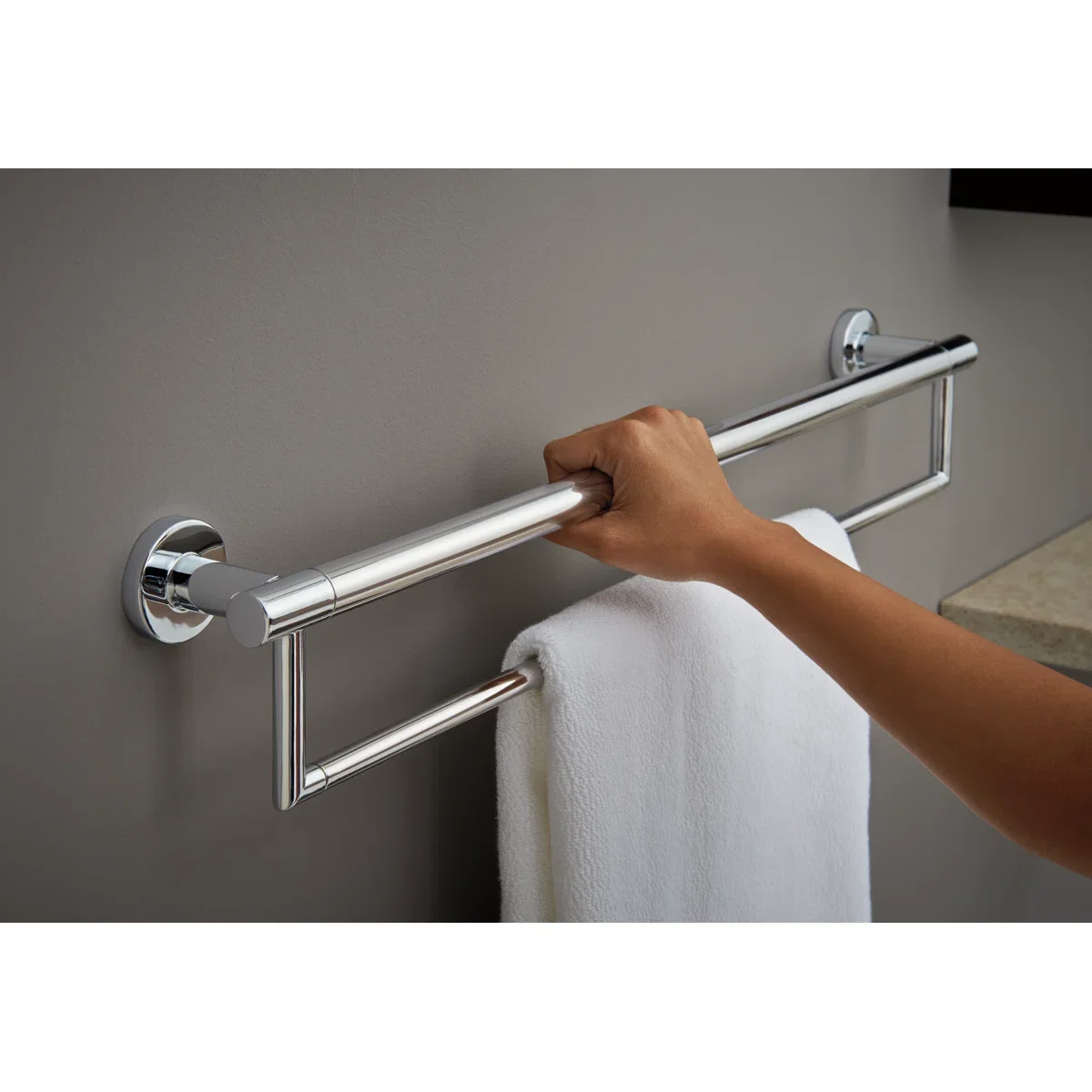
Designer grab bars are load-rated grab bars finished to match bathroom fixtures, in brushed nickel, oil-rubbed bronze, matte black, chrome, and brushed brass, and many of them are shaped as towel bars, shelves, and toilet paper holders so the support disappears into the room. The look is why families choose them. The load rating is why they work. On home visits across Southern California, about 3 in 4 bathrooms already have a towel bar being used as a grab bar. A designer grab bar is that towel bar built to hold a person, and the difference between the two is invisible from across the room. The finishes, the dual-purpose designs, the sizes, and how to read a product listing so you buy the one that holds follow.
- A designer grab bar is a grab bar first. It carries a published load rating, usually 250 to 500 pounds, and mounts into structure. The finish is the last decision, not the first.
- Match the finish to the faucet and shower trim, and choose a brushed or textured surface over a polished one where a wet hand will hold it.
- Bars that double as towel bars, shelves, and toilet paper holders put real support where the bathroom already has a fixture. A towel bar cannot be used the other way around.
- "ADA compliant" on a listing means diameter and clearance. It does not tell you the bar will hold. The load rating does.
- The wall decides. A 500-pound bar in drywall alone holds what drywall holds.
Do grab bars have to look institutional?
No. The textured stainless rail from a commercial restroom is one product category, and it is no longer the only one. Manufacturers now make load-rated grab bars as bathroom hardware, in the same finishes and profiles as faucets and towel bars, with concealed mounting flanges and no visible screws. A guest reads them as a towel rail or an accent piece. The person who needs them gets a bar that holds.
The look matters for a reason beyond taste. The commercial rail carries a message, that someone in this house is frail, and that message is why families put off the conversation until a fall forces it. On home visits, roughly 1 in 10 bathrooms had a grab bar of any kind, and 3 in 4 had a towel bar doing the job instead. The towel bar was chosen because it looked like it belonged. A designer grab bar looks like it belongs and holds.
What finishes do designer grab bars come in?
Designer grab bars come in the standard bathroom fixture finishes: brushed nickel, oil-rubbed bronze, matte black, polished and brushed chrome, brushed stainless, and brushed brass or gold. The right finish is the one already on the faucet and the shower trim, so the bar reads as part of a set rather than an addition. Where the bathroom mixes finishes, match the fixture nearest the bar: the shower trim for a shower bar, the faucet for a bar beside the sink or toilet.
Grip comes before color
The finish is a safety decision before it is a design decision. A polished surface is slick under a wet, soapy hand. A brushed, peened, or knurled surface gives the hand something to hold. Most designer lines offer the same bar in both, so the choice is between a polished chrome bar the hand slides on and a brushed nickel bar it grips, at the same price and in the same profile. In a shower or beside a tub, choose the textured surface. Beside a toilet, where hands are dry, polished is a reasonable choice if the fixtures are polished.
How finishes hold up in a shower
Designer bars are stainless steel or brass under the finish, and the finish is applied over the metal. Stainless and brass do not rust. The finish can wear where a hand holds the same spot every day, and a dark finish shows that wear before a light one does. Manufacturers back their finishes with warranties that run from a limited lifetime down to a few years; the warranty term on the listing is a fair proxy for how the finish will look in five years.
Which grab bars double as towel bars, shelves, and toilet paper holders?
Three categories of dual-purpose grab bar exist, and each puts a load-rated bar inside a fixture the bathroom would have anyway.
- Towel bars and towel rings built as grab bars. A straight bar beside the shower or a ring beside the sink, mounted into structure and rated for a person's weight. This is the closest match for the towel bar 3 in 4 bathrooms are already grabbing.
- Corner shelves and shower caddies with a load-rated frame. The frame is the grab bar; the shelf holds shampoo. Placed at the shower entry, it is the vertical support a person reaches for while stepping in.
- Toilet paper holders on a weight-bearing bar. The roll mounts on a short horizontal bar beside the toilet, exactly where a person pushes up from.
A grab bar can be used as a towel bar. A towel bar cannot be used as a grab bar. A retail towel bar is held to the wall by set screws into a small post, fastened into drywall with hollow-wall anchors, and rated for the weight of a towel. On home visits, the towel bar being used as a grab bar is the single most common thing we find, and it pulls out of the wall under a person's weight. A dual-purpose grab bar mounts through a flange with three screws into a stud, blocking, or a load-rated anchor, and carries a published rating.
How do you tell a load-rated designer bar from a decorative one?
Read the listing for a load rating in pounds, and read the condition attached to it. A grab bar lists a number: 250 pounds, 500 pounds. A decorative bar lists a finish and a length and no number, because it was never tested to hold a person. That single line separates the two products, and everything else on the listing, the finish, the profile, the concealed screws, can be identical.
What the rating means, and what it does not
The 2010 ADA Standards set the reference load at 250 pounds applied vertically or horizontally at any point on the bar, the fasteners, the mounting device, or the supporting structure (Section 609.8). The word to hold onto is "structure." The rating is for the whole assembly, and the manufacturers say so: their designer lines are rated to 500 pounds "when installed into a stud" or with the maker's own load-rated anchors. Screw the same bar into drywall and the rating no longer applies. The bar is as strong as what it is screwed into.
What "ADA compliant" means on a listing
"ADA compliant" means the bar's diameter and wall clearance fall within Section 609: a round bar 1 1/4 to 2 inches across, mounted with 1 1/2 inches of space behind it so fingers fit and a forearm cannot slip through. It does not mean the bar has been tested to hold a person, and there is no ADA approval program that tests bars. A bar can be ADA compliant and decorative at the same time. The load rating is the line that matters.
Lines that publish a rating
Three examples of designer lines that publish a load rating on the product listing, so you can see what the number looks like: the Moen Home Care collection lists 500 pounds when installed into a stud or with Moen's SecureMount anchors, in brushed nickel, chrome, matte black, and stainless; the Invisia Accent Ring, a towel ring built as a grab bar, lists 500 pounds; and the HealthCraft Plus Crescent Ring lists 500 pounds. These are examples of what a rated listing looks like, not a product recommendation. Any bar with a published rating in pounds and a flange that mounts into structure passes the same test.
| Retail towel bar | Designer grab bar | Commercial grab bar | |
|---|---|---|---|
| Load rating on the listing | None | 250 to 500 pounds, with a mounting condition | 250 to 500 pounds |
| How it mounts | Set screw into a small post; hollow-wall anchors | Flange with three screws into a stud, blocking, or a load-rated anchor; screws concealed | Flange with three screws; screws exposed or concealed |
| Diameter | Often under 1 inch | 1 1/4 to 1 1/2 inches, within the ADA range | 1 1/4 to 1 1/2 inches, within the ADA range |
| Finish | Any | Brushed nickel, bronze, matte black, chrome, brass, stainless | Peened or polished stainless |
| Reads as | Hardware | Hardware | Medical equipment |
Does the listing state a load rating in pounds, and what mounting does it require to earn that rating?
Is the surface brushed, peened, or knurled where a wet hand will hold it?
Is the diameter 1 1/4 to 2 inches, with 1 1/2 inches of clearance from the wall?
Does it mount through a flange into structure, rather than a set screw into a post?
What size designer grab bar do you need?
Size is two decisions: the diameter the hand grips, which is the same for every good bar, and the length and height for the spot, which follow the reference layout and then the person's reach.
| Measurement | Reference | Source |
|---|---|---|
| Diameter | 1 1/4 to 2 inches for a round bar | ADA 609.2.1 |
| Clearance behind the bar | 1 1/2 inches from the wall | ADA 609.3 |
| Height | 33 to 36 inches from the floor to the top of a horizontal bar | ADA 609.4 |
| Load | 250 pounds at any point on the bar, fasteners, mounting, or structure | ADA 609.8 |
| Toilet side wall | At least 42 inches long, no more than 12 inches from the rear wall | ADA 604.5.1 |
| Toilet rear wall | At least 36 inches long | ADA 604.5.2 |
| Bathtub back wall | Two horizontal bars, one at 33 to 36 inches and one 8 to 10 inches above the rim | ADA 607.4 |
| Vertical bar at an entry | 18 inches long, above the horizontal bar | ICC A117.1, 607.4 and 608.3.1 |
The ADA and A117.1 were written for public buildings and are not required in a private home. They are the starting point; the person's reach sets the final position.
Designer bars sell in lengths from about 12 to 48 inches. A 12 to 18 inch bar mounted vertically serves a shower or tub entry. A 24 inch bar serves a tub control wall or a spot within reach of a shower seat. A 24 to 36 inch bar serves the long wall of a shower. A 36 to 42 inch bar serves the toilet side wall. Which type goes where, and why, is covered in vertical vs. horizontal grab bars.
Why the wall matters more than the bar
A 500-pound designer bar screwed into drywall alone holds what drywall holds, and a plain bar screwed into a stud holds a person. Behind the tile in most of the homes we visit there is drywall and nothing else. No blocking was installed when the house was built, so a bar cannot be screwed into "the wall." It has to reach a stud, or blocking has to be added behind the wall, or a load-rated anchor designed for the wall type has to carry the load. The designer bar's concealed flange hides which of those was done, which is why the anchor point should be documented in writing when the bar goes in.
A bathroom remodel is the one time blocking can go in everywhere at low cost, before the walls close. A tub-to-shower conversion is the moment to add it, so a bar can be placed anywhere later without opening the wall again. What the bar is screwed into, by wall type, is covered in the grab bar installation guide. How Ace Access Homes anchors and documents each bar is on grab bar installation.
What does not work
- A towel bar used as a grab bar. Found in about 3 of every 4 bathrooms on home visits. It pulls out under body weight.
- A decorative bar with no load rating. Same finish, same shape, no number on the listing. It was never tested to hold a person.
- A rated bar in drywall. The rating assumes a stud or the maker's anchor. Plastic anchors back out of the drywall under a fall. Bars in tile with plastic anchors are one of the failures we find most often.
- Polished chrome where a wet hand holds it. The hand slides at the moment of maximum load. Brushed or knurled in the shower.
- A bar placed where the stud is rather than where the hand lands. The finish is right, the anchoring is right, and the bar is six inches from where the person reaches. Placement follows the person; the anchoring is made to fit the placement, not the other way around.
- Suction-cup and no-drill bars, in any finish. In laboratory testing at the KITE Research Institute, every suction-cup handhold tested failed within 28 days, and at least one failed on the first day on every wall surface.
Frequently asked questions
Do grab bars have to look medical?
No. Designer grab bars come in brushed nickel, oil-rubbed bronze, matte black, chrome, and brushed brass, with concealed screws and the profiles of bathroom hardware, and many are built as towel bars, shelves, and toilet paper holders. They carry the same load rating as a commercial bar. A guest reads them as fixtures; the person who needs them gets a bar that holds.
What is the best finish for a grab bar?
The finish that matches the faucet and shower trim already in the room, in a brushed, peened, or knurled surface where a wet hand will hold it. Polished finishes are slick when wet. Function is the same across colors, so the choice between brushed nickel, oil-rubbed bronze, matte black, chrome, and brass is a matching decision; the choice between polished and textured is a safety decision.
Can a grab bar be used as a towel bar?
Yes. A load-rated grab bar holds a towel every day and a person when it matters, and several lines are shaped as towel bars and towel rings for that purpose. The reverse is not true. A retail towel bar is fastened with set screws and hollow-wall anchors and rated for a towel, and it pulls out of the wall under a person's weight.
Are there grab bars that look like towel bars?
Yes. Several manufacturers make load-rated grab bars in the shape of a towel bar, a towel ring, a corner shelf, or a toilet paper holder, with a concealed mounting flange and a published rating of 250 to 500 pounds. They are sold as designer or hidden grab bars. The listing shows the rating in pounds; a decorative bar of the same shape does not.
Do designer grab bars meet ADA standards?
The rated ones meet the ADA reference dimensions: a round bar 1 1/4 to 2 inches in diameter, 1 1/2 inches of clearance from the wall, and a 250-pound load carried by the bar, the fasteners, and the structure together. In a private home the ADA is a reference, not a requirement. "ADA compliant" on a listing covers diameter and clearance; the load rating in pounds is the line that shows the bar will hold.
What size designer grab bar do I need?
A round bar 1 1/4 to 2 inches in diameter with 1 1/2 inches of clearance from the wall. Length follows the location: 12 to 18 inches mounted vertically at a shower or tub entry, 24 inches on a tub control wall or within reach of a shower seat, 24 to 36 inches on the long shower wall, and 36 to 42 inches on the toilet side wall. The final height is set to the person's reach.
Who installs designer grab bars in Southern California?
Ace Access Homes is a licensed California contractor, CSLB #1087045, and places and installs designer grab bars in brushed nickel, oil-rubbed bronze, matte black, and chrome, anchored into structure and fitted to the person, across Ventura County, the Conejo Valley, and the greater Los Angeles area, including Thousand Oaks, Westlake Village, Camarillo, Oxnard, Ventura, Simi Valley, and Santa Barbara. Every project starts with a free virtual Home Safety Check or a Free In-Home Estimate. Call or text (805) 500-0801.
Safety that looks like design, in the finish already in the room.
A free virtual Home Safety Check walks the bathroom with you over video in about 20 minutes. No one comes to the house, nothing is sold, and you finish with a written list of where each bar belongs and which finish matches what is there. If you already know what you need, schedule a Free In-Home Estimate and we mark the wall with the person standing there.
Book the Free Home Safety CheckOr call or text (805) 500-0801 to schedule a Free In-Home Estimate. For a full clinical audit with a written Home Safety Report, ask about the Home Safety Assessment.
- U.S. Access Board, 2010 ADA Standards for Accessible Design, Chapter 6: Plumbing Elements and Facilities (Sections 604.5, 607.4, 609.2.1, 609.3, 609.4, and 609.8)
- International Code Council, ICC A117.1, Accessible and Usable Buildings and Facilities, 2009 and later editions (vertical grab bars at bathtubs and transfer showers, Sections 607.4 and 608.3.1)
- Deen HHZ, Levine IC, Montgomery RE, Pong S, Novak AC, Suction cup handholds have low efficacy in laboratory evaluation with typical bathing conditions and wall materials, Journal of Rehabilitation and Assistive Technologies Engineering, August 2025
- Moen Home Care collection product listings, 24-inch designer grab bar, brushed nickel (500-pound rating when installed into a stud or with SecureMount anchors; 1.25-inch diameter)
- Invisia, Accent Ring designer grab bar (500-pound rating)
- HealthCraft, Plus Crescent Ring decorative grab bar (500-pound rating)
- Ace Access Homes home-visit observations, Southern California, 2026 (approximate counts; grab bar presence, towel bars in use as grab bars, bar placement, and wall construction)
This guide is for educational purposes and is not a substitute for seeing the room and the person. ADA and A117.1 dimensions are reference starting points written for public buildings and are not required in a private home. Product ratings are quoted from manufacturer and retailer listings as of August 2026 and apply only under the mounting conditions the manufacturer states; confirm current specifications before purchase. Manufacturer names are examples of lines that publish a load rating, not endorsements.
